
Last updated: 12 November 2026. Visa and TDAC rules, and the live Phuket–Krabi package price, were rechecked on this date.
If you are planning a Thailand trip from India, the first practical question is no longer “do I need a visa on arrival?” It is whether the current 30-day visa exemption still applies to your passport and purpose, and what you must file before you fly. This guide sticks to official embassy and immigration pages, flags a few stale official-looking sources, and uses ClickMakeTrip’s live Phuket–Krabi package only as a worked example.
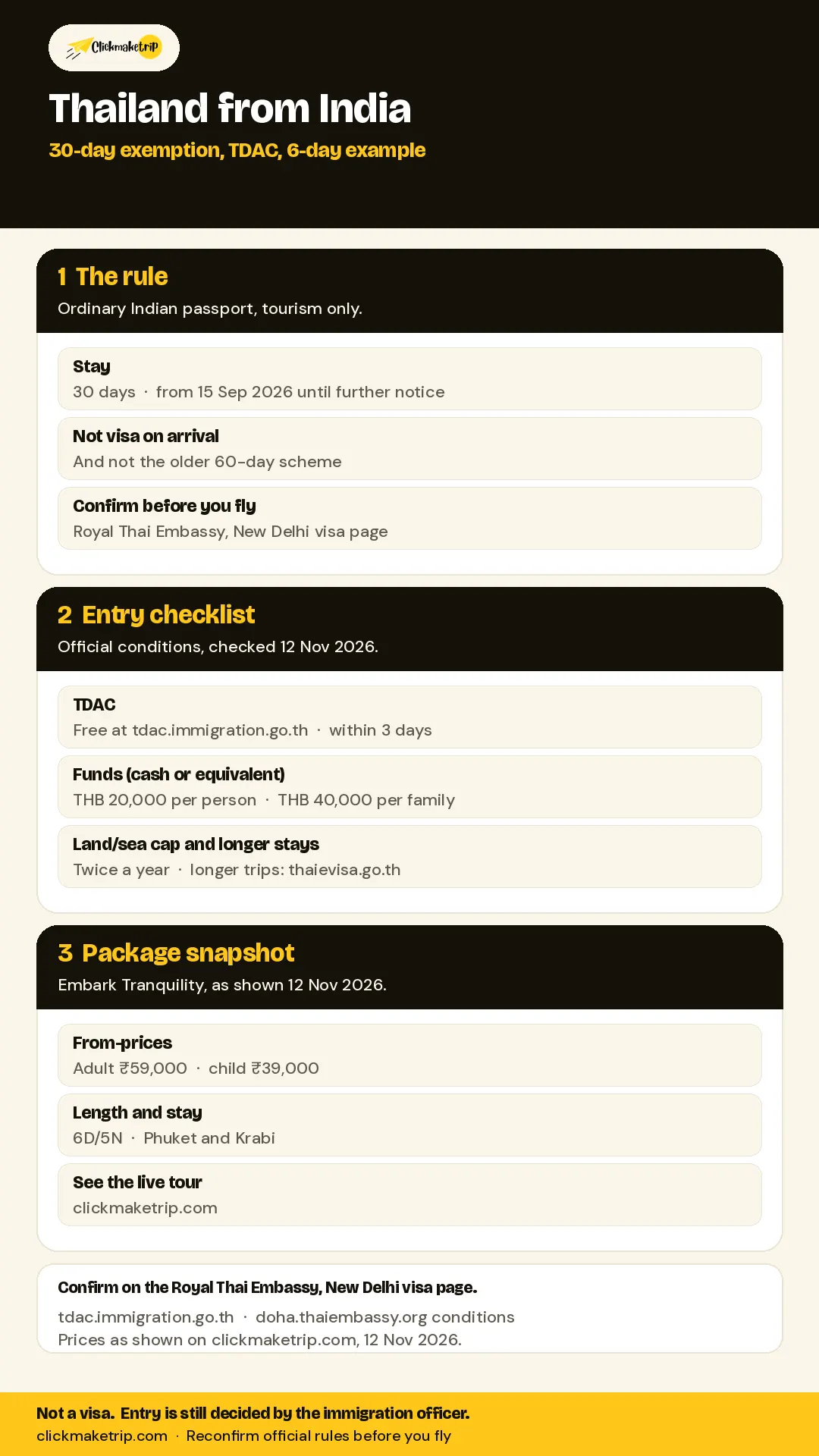
Quick answer: From 15 September 2026, Indian ordinary passport holders can enter Thailand for tourism under a 30-day visa exemption (Thai Embassy, New Delhi; still current on 11 November 2026, rechecked 12 November 2026). This is not visa on arrival. File a free TDAC within three days before arrival. ClickMakeTrip’s Embark Tranquility in Phuket and Krabi package is 6D/5N, from ₹59,000 per adult and ₹39,000 per child (checked 12 Nov 2026).
Is Thailand visa-free for Indians in 2026?
The current official rule is a 30-day visa exemption
The Royal Thai Embassy, New Delhi visa page, last updated 11 November 2026 and rechecked on 12 November 2026, states that the 30-day visa exemption for Indian ordinary passport holders for tourism purposes only remains effective from 15 September 2026 until further announcement. The Embassy’s 15 September 2026 announcement says the scheme officially took effect on that date.
This is an exemption, not a visa, and not a guarantee of admission. The immigration officer still decides entry.
India is on the official 30-day list
India appears as entry 22 on the Department of Consular Affairs list (ผ.30) of countries and territories whose nationals, travelling on an ordinary passport for tourism, are entitled to a stay not exceeding 30 days. The list is dated 15 September 2026. Being on the list still does not override an officer’s decision at the border.
This is not visa on arrival
Do not treat the exemption as a visa-on-arrival process, and do not budget for a VoA fee unless a current official page has changed. The Royal Thai Embassy in Doha conditions page, updated 16 September 2026 and rechecked on 12 November 2026, lists India under the 30-day exemption. The official VoA list in force from 15 September 2026 on that page is Azerbaijan, Belarus and Serbia only.
A historical note: 60 days is no longer the current India-facing rule
A longer exemption, commonly described as 60 days, was in force before the 2026 revision. Treat 60-day wording as a superseded historical scheme, not as the rule you should follow today.
For context only, a New Delhi Embassy update dated 27 July 2026 recorded that the Thai Cabinet approved the 30-day scheme on 14 July 2026, and that it would take effect 15 days after the Ministry of Interior announcement was published in the Royal Gazette. The same update said travellers already in Thailand under the then-current scheme, or entering before the new effective date, could remain until their then-permitted stay expired. We do not invent the Gazette publication date here. Once the new scheme took effect, the same update pointed travellers planning a stay longer than 30 days to an appropriate e-visa at thaievisa.go.th.
Some official-looking pages are out of date. The Royal Thai Consulate-General, Kolkata travel advisory was last updated 11 November 2025 and still says Indian nationals may stay up to 60 days. That conflicts with the New Delhi page updated 11 November 2026 and with the ผ.30 list dated 15 September 2026. Do not follow the Kolkata advisory as a current rule.
Who the exemption covers, and who it does not
Ordinary Indian passports, tourism only
The New Delhi wording is specific: Indian ordinary passport holders, for tourism purposes only. Work, business, study and longer stays need the correct visa from the New Delhi visa page or the e-visa site. Official exemption conditions on the Doha page also say the tourist visa exemption does not apply to holders of a Travel Document for Aliens issued by a listed country.
If you plan to stay longer than 30 days
Apply for an appropriate e-visa at thaievisa.go.th before you travel. Official New Delhi tourist-visa (TR) fees, if you use that route rather than the exemption, are INR 3,000 for a single-entry visa (3-month visa validity, 60-day stay) and INR 13,500 for a multiple-entry visa (6-month visa validity, 60-day stay), as shown on the visa page updated 11 November 2026. Those are visa fees, not exemption fees, and the 60-day stay in that table is the tourist-visa stay, not the current exemption.
What to arrange before you fly
Thailand Digital Arrival Card (TDAC)
TDAC is not a visa and not permission to enter. It is a mandatory arrival card for all non-Thai nationals, including infants and children. The official TDAC FAQ, rechecked 12 November 2026, says to submit it within three days before arrival, including the arrival date (also described as up to 72 hours). Use only the official Immigration Bureau site, tdac.immigration.go.th (the form currently opens at /arrival-card/).
- File a new TDAC for every entry. It is valid for one arrival on the date you enter.
- Air, land and sea arrivals all need it. If you remain in international transit and do not pass through immigration, it is not required; if you leave the airport, it is.
- You do not have to print it if you can show the QR code on a phone or other device. The official FAQ still suggests a paper copy if you will not have a device.
- Phuket Airport is one of the official kiosk airports, along with Suvarnabhumi, Don Mueang, Chiang Mai and Hat Yai.
The Embassy of India in Bangkok advisory of 25 April 2025 also directed travellers to the same official URL from 1 May 2025.
TDAC is free: ignore paid lookalike sites
The official FAQ’s own banner says no fees are required. A Ministry of Tourism and Sports notice published on 17 October 2025 warns that websites charging a fee for “TDAC registration” are not official Thai government sites. File the form yourself on the official Immigration Bureau URL. Do not pay a third party for it.
Funds: official wording, not a fixed rupee cash bundle
The official Doha exemption conditions say travellers under the tourist visa exemption schemes “must possess adequate cash of or equivalent to 20,000 Baht per person or 40,000 Baht per family.” That is cash or equivalent, not a requirement to carry one fixed rupee amount in notes.
For context only, at the indicative ExchangeRate-API rate of 1 THB = 2.778935 INR as of 12 November 2026, 00:02 UTC (05:32 IST), THB 20,000 is about ₹55,579 and THB 40,000 is about ₹1,11,157. Frankfurter/ECB quoted 1 THB = 2.781 INR on 11 November 2026, or about ₹55,620 and ₹1,11,240. Both conversions are approximate; the amount in rupees moves with the rate. Recheck the official wording before you fly.
Land and sea borders, and extensions
Under the same official conditions, visa-exempt entry through land or sea checkpoints is permitted only twice per calendar year, except for nationals of Malaysia, Brunei Darussalam, Indonesia and Singapore. India is not in that exception list, so the cap applies to Indian travellers using land or sea checkpoints. The conditions page does not describe air arrivals as counting toward that cap, and we do not invent a flight cap.
The stay can be extended at the discretion of the immigration officer. You must apply before the permitted stay ends. We do not promise a set extra length or a set fee.
Passport validity and hotel bookings
A six-month passport-validity rule and confirmed hotel bookings appear on the official VoA requirements list, and in unofficial round-ups. They were not listed on the official exemption-conditions text we rechecked on 12 November 2026, and they are not in the New Delhi 30-day announcement. Airlines and immigration can still ask for evidence that the trip is genuine tourism and that you will leave within the permitted stay. Recheck the New Delhi Embassy page and your airline before you travel. Do not treat a six-month passport rule as an official exemption condition unless a current official exemption page says so.
A 6-day Phuket and Krabi example (from the live package)
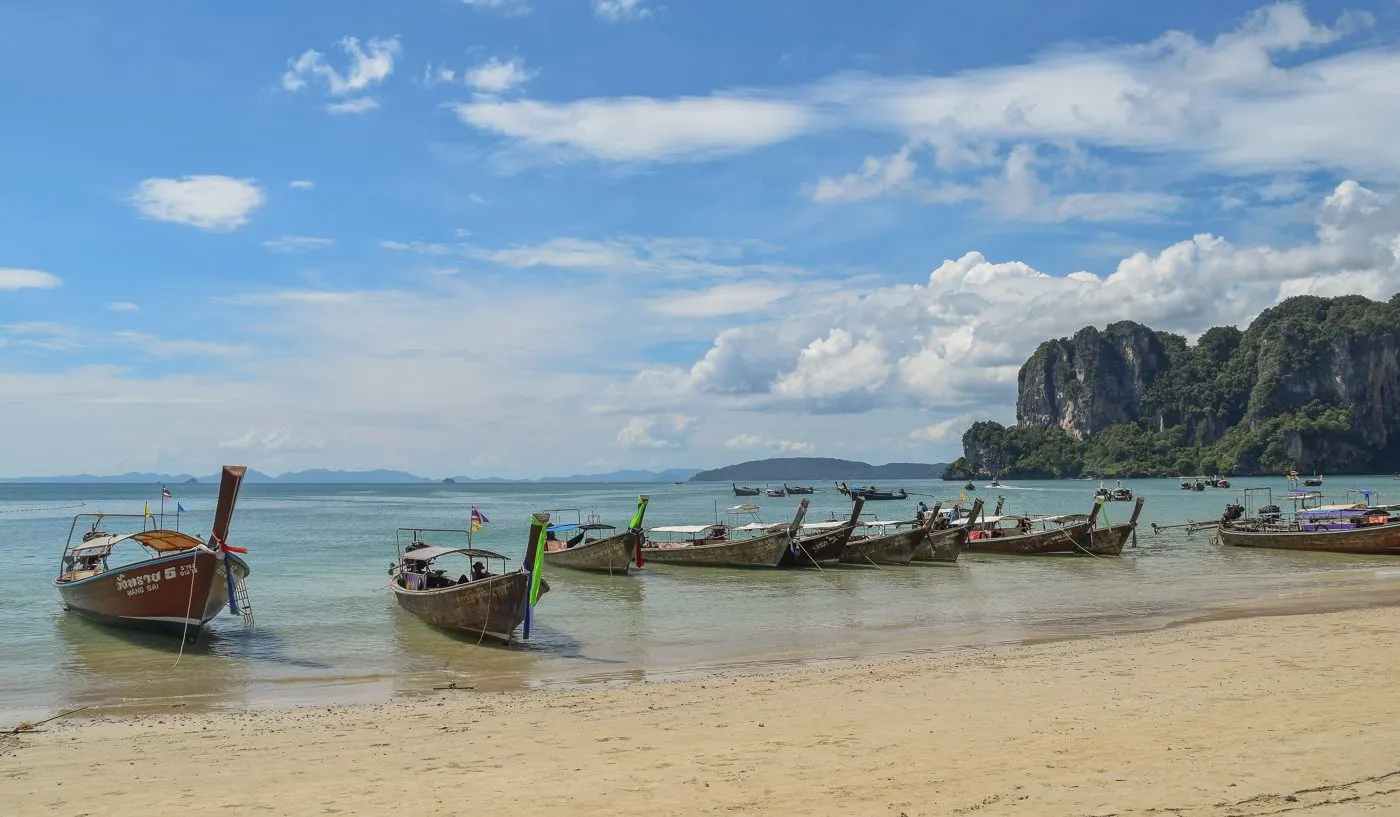
The 30-day exemption is the rule for a typical short holiday. ClickMakeTrip’s live Embark Tranquility in Phuket and Krabi package is a worked example, not a December itinerary and not a reason to treat the exemption as a 30-day guaranteed holiday.
What the live page shows (checked 12 November 2026)
The tour is listed as 6 days / 5 nights, from ₹59,000 per adult and ₹39,000 per child.
Six days sits well inside the 30-day exemption. If you want a longer Thailand stay, ask for a customised plan or apply for the correct e-visa. The exemption is not a promise that every traveller will be admitted for a full 30 days.
Package snapshot
| Package | Length | From-price (12 Nov 2026) |
|---|---|---|
| Embark Tranquility in Phuket and Krabi | 6D/5N | ₹59,000 per adult; ₹39,000 per child |
| Singapore + Malaysia + Thailand | 10N/11D | ₹129,000 per person |
The multi-country tour is an optional related option. The Thailand portion of that trip still needs the same 30-day exemption and TDAC rules for entry to Thailand. This post does not set out Singapore or Malaysia visa rules.
Plan a Thailand trip with ClickMakeTrip
Start with the live Phuket–Krabi 6D/5N package, or browse the Thailand destinations hub, all packages and book a free planning call. Our Visa & Budget and Travel Tips guides collect other entry-rule explainers.
If you are comparing other trips, the Bali trip-cost guide covers a different entry regime (Indonesia e-VOA and the Bali levy). The Vietnam and Cambodia guide is a related Southeast Asia option, and the Schengen visa guide is a visa-rule sibling for a different region.
Thailand visa exemption for Indians: FAQs
Is Thailand visa-free for Indians in 2026?
For tourism on an ordinary Indian passport, yes, under a 30-day visa exemption in force from 15 September 2026 until further announcement (Royal Thai Embassy, New Delhi, page updated 11 November 2026, rechecked 12 November 2026). It is an exemption, not a visa, and admission is still decided at immigration.
Did the rule used to be 60 days?
A longer exemption was in force before the 2026 revision. The current official India-facing wording is 30 days. Ignore pages and posts that still say 60 days unless they are clearly historical. The Kolkata Consulate advisory last updated 11 November 2025 is one such stale page.
Do Indians need visa on arrival for Thailand now?
No, not under the official lists checked on 12 November 2026. Indian ordinary passports are on the 30-day exemption list. The official VoA list from 15 September 2026 is Azerbaijan, Belarus and Serbia only.
How long can I stay?
Up to 30 days for tourism under the exemption. For a planned stay longer than 30 days, apply for the appropriate e-visa at thaievisa.go.th. Any extension after arrival is at the immigration officer’s discretion; we do not promise a set extra period or fee.
What is TDAC, and is it a visa?
No. The Thailand Digital Arrival Card is a free, mandatory arrival declaration for non-Thai nationals, submitted at tdac.immigration.go.th within three days before arrival (including the arrival date). Children need one too. It is not permission to enter. Avoid paid lookalike sites.
How much money do I need to show?
Official wording: adequate cash or equivalent to THB 20,000 per person or THB 40,000 per family. That is not the same as a fixed rupee cash bundle. At the indicative 12 November 2026 rate, THB 20,000 is about ₹55,579. Recheck the official page, because the rupee amount moves with the rate.
Do I need a passport valid for six months and a hotel booking?
Those items are official VoA requirements and appear in unofficial round-ups, but they were not listed on the official exemption-conditions text checked on 12 November 2026. Recheck the New Delhi Embassy and your airline before you travel, and be ready to show that the trip is tourism and that you will leave within 30 days.
Does the exemption apply at land borders?
Yes, but official conditions limit visa-exempt land and sea entries to twice per calendar year for most nationalities, including India. Malaysia, Brunei, Indonesia and Singapore are the named exceptions. File a new TDAC for every entry, including a land return. The official conditions page does not describe a cap for air arrivals.
How much is a Phuket and Krabi package from India?
ClickMakeTrip lists Embark Tranquility in Phuket and Krabi, a 6D/5N tour, from ₹59,000 per adult and ₹39,000 per child (checked 12 November 2026).
Is December a good time to go?
This post is not a weather guide. The 30-day exemption is not month-specific. Check a current official or meteorological forecast for the Andaman coast, and confirm peak-holiday crowding with the planner. We do not invent rainfall tables or hotel-rate claims here.
What if I am transiting through Bangkok or Phuket?
Official TDAC FAQ: if you do not pass through immigration, TDAC is not required; if you leave the airport, it is. Airline and transit-visa rules are separate, so check the airline.
Can I work or do a long stay on the exemption?
No. Official wording is tourism only. Use the correct visa type from the New Delhi visa page or thaievisa.go.th.
Sources, last checked 12 November 2026: Royal Thai Embassy, New Delhi visa page (updated 11 November 2026); New Delhi 15 September 2026 announcement; New Delhi 27 July 2026 update (historical context); MFA ผ.30 list, 15 September 2026; Royal Thai Embassy, Doha, exemption and VoA conditions (updated 16 September 2026); official TDAC FAQ and tdac.immigration.go.th; thaievisa.go.th; Embassy of India, Bangkok, TDAC advisory; Ministry of Tourism and Sports warning on paid lookalike sites, 17 October 2025. Indicative THB to INR from ExchangeRate-API (12 November 2026, 00:02 UTC) and Frankfurter/ECB (11 November 2026). Tour prices from the live ClickMakeTrip Phuket–Krabi and Singapore–Malaysia–Thailand pages on 12 November 2026. The Kolkata Consulate advisory updated 11 November 2025 is cited only as a stale official-looking page. This is general guidance, not a visa decision or a guaranteed quote. Entry remains at the immigration officer’s discretion.

Travel expert at ClickMakeTrip. Planning something similar? Book a free call and we’ll build it for you.