

Last updated: 7 November 2026. Official visa guidance checked: 7 November 2026.
A Schengen visa application is easier to organise when you separate three questions: which country should handle it, what your documents need to show, and how much time the process might take. This guide is for applicants in India planning a short visit to the Schengen area, particularly ordinary Indian passport holders travelling for tourism. Business visits, family visits and special immigration statuses can require different evidence. Use your destination consulate’s own checklist alongside this guide, not instead of it.
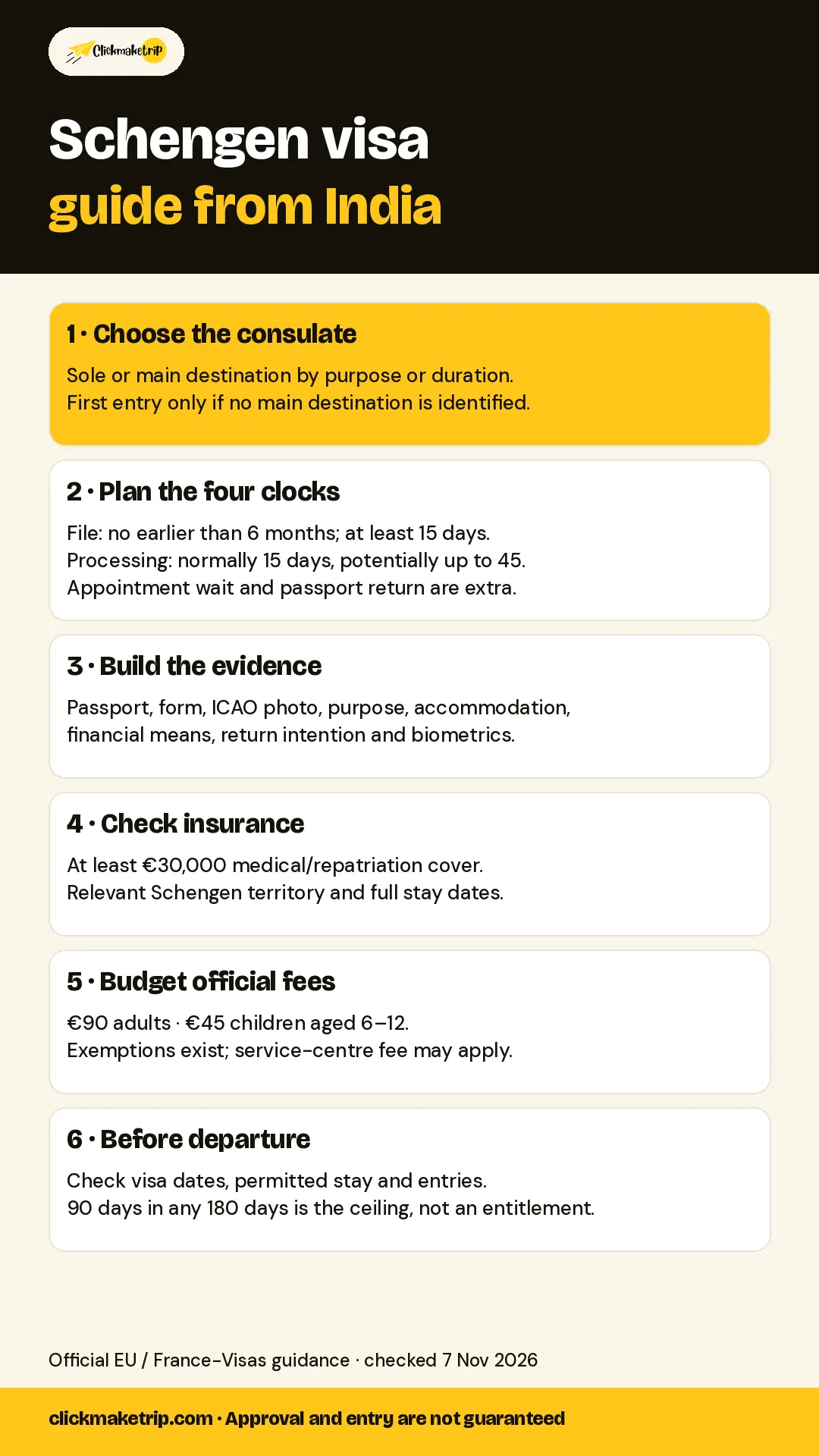
Quick answer: A short-stay Schengen visa concerns visits of up to 90 days in any 180-day period, subject to the shorter stay, validity and entry limits on your visa. Apply to the appropriate destination country through its official process. The normal filing window is no earlier than 6 months and at least 15 days before travel; processing normally takes 15 days and can extend to 45. Appointment waits and passport return need separate allowance. Standard fees are €90 for adults and €45 for children aged 6–12, with exemptions for some applicants. Neither a booking nor a visa guarantees entry.
What a short-stay Schengen visa covers
Tourism, visiting relatives and short business trips are common reasons for a short-stay visa. It is not a substitute for permission to move abroad, undertake a long course or work where separate authorisation is required. Check your purpose in the official destination-country visa wizard before choosing a category.
The ceiling is 90 days in any rolling 180-day period, not 90 days in every country. Moving from France to Switzerland does not restart the allowance. A visa valid for a year does not mean you may stay for a year: follow its validity dates, authorised duration and number of entries as well as the rolling limit. A single-entry visa also raises different questions from a multiple-entry visa if you plan to leave and re-enter the area.
Schengen and the European Union are not interchangeable. France-Visas notes that the UK and Ireland are outside the Schengen scheme and that a Schengen visa does not cover France’s non-European territories. Read the territorial validity on the visa itself. The official short-stay explanation links to the EU stay calculator; its result is a planning aid, not a legally binding decision.
Which country should receive your application?
For a trip to one Schengen country, apply to that country. For several countries, identify the main destination. The Commission’s public guide describes the longest stay and, for stays of equal length, the first country you visit. France’s official short-stay guidance adds the important nuance: the main destination can be determined by duration or purpose of stay. First entry is the fallback when no main destination can be identified, not a free choice of consulate.
- Tourism only: if France is your longest stay, arriving through another Schengen country does not by itself make that other country the correct place to apply.
- Mixed purposes: a business event or study purpose may affect the main destination even if you add leisure days elsewhere. Ask the responsible consulate rather than deciding from hotel counts alone.
- If purpose does not distinguish a main destination and your stays are equal, use the first country you will visit under the official rules.
- Do not invent extra hotel nights to use a different appointment system. Your application should describe the trip you actually intend to take.
For a route such as our France and Switzerland tour or Spain and Portugal tour, settle the genuine purpose and country-by-country schedule before choosing the application channel. A tour name alone does not determine jurisdiction.
Where to apply when you live in India
As a general rule, apply at the consulate with territorial responsibility for the country where you are legally resident. Being an Indian citizen and being legally resident in India are different things. If you live abroad, consult the destination consulate serving your country of legal residence. Within India, use the destination country’s local instructions for the responsible office and service centre.
France-Visas says an application outside the country of legal residence may be considered where the applicant can explain why it could not be lodged there, for example unexpected circumstances. That is not a general invitation to apply wherever a slot is available. Check acceptance with the competent consulate first.
When to apply: four separate clocks
- Filing window: the Commission says to submit at least 15 days before the intended journey and no earlier than 6 months beforehand. Treat the 15-day figure as the normal minimum lead time, not a safe planning deadline; consulate requirements and applicable exceptions still matter.
- Appointment: you may need to book before lodging. Waiting for a slot is not the same as having submitted an application. No live availability is claimed here.
- Processing: normally 15 days; it may extend to up to 45 days if further examination or documents are needed. A complete file helps, but does not buy a guaranteed turnaround.
- Passport return: allow separately for collection or courier after a decision. Ask the official centre how you will be notified and how return works.
Start with a real itinerary and check appointments early. If you cannot leave enough room for processing and passport return, reconsider your dates rather than treating the minimum lead time as a promise. The Commission also notes a free and accelerated procedure under certain conditions for family members covered by the EU/EEA Free Movement Directive; do not assume the ordinary tourist procedure is the only one for every applicant.
Documents: build the file around your actual trip
The European Commission gives the common requirements below. There is no single universal India checklist covering every consulate, occupation and purpose. Download the current checklist generated or published by your responsible consulate, and follow its rules for copies, translations, signatures and any additional evidence.
- Passport: the Commission says expiry should be at least 3 months after departure from the Schengen area; for multiple-entry visas it describes validity at least 3 months after departure from the last country visited. Also check the destination’s travel-document issue-date and blank-page rules before booking. This guide does not assign unsourced universal numbers to those additional requirements.
- Application form and photo: use the correct form and a photo meeting ICAO standards. A passport photo you happen to have may not be compliant.
- Purpose: an honest itinerary and the evidence appropriate to tourism, business, family visit or another declared purpose.
- Accommodation: evidence for your stays. A private host may involve a different official document from a hotel booking; France, for example, has a specific accommodation certificate process.
- Financial means: evidence you can fund the visit. Use the destination checklist for acceptable bank, employment or sponsorship evidence; there is no universal bank balance quoted here.
- Return intention: evidence supporting your intention to return home after the stay. Choose documents that genuinely reflect your circumstances.
- Insurance: a certificate meeting the cover, territory and date requirements described below.
- Additional documents: a consulate may request further evidence. Respond consistently and keep a copy of what you submit.
Travel medical insurance: amount, territory and dates
France-Visas specifies at least €30,000 cover for medical repatriation and emergency and/or hospital treatment. It must be valid throughout the territory of the Schengen Member States applying the agreement and for the duration of your stay, with services accessible in the area. The Commission also lists repatriation including in the event of death. Do not assume a domestic health policy, a credit-card benefit or a policy covering just one stop meets those conditions.
Read the certificate and exclusions, not just the product name. Check that your name, travel dates, territory and medical/repatriation cover match your application. France-Visas tells multiple-entry visa holders to carry a health-insurance certificate on every trip. Confirm any specific exception with your consulate.
Official visa fees and exemptions
| Applicant or charge | Official guidance |
|---|---|
| Standard adult short-stay visa fee | €90 |
| Children aged 6–12 | €45 |
| Children under 6 | Fee exemption described by France-Visas |
| Visa service centre | An additional fee may apply |
Fees can be waived for specific categories. France-Visas identifies school-trip visa applications as free; other education, family or special-status cases need the responsible consulate’s assessment. Do not confuse a visa-fee exemption with an automatic exemption from every service or optional courier charge. No INR conversion is given here: consult the official local payment instructions for the amount and accepted method.
France-Visas states that visa fees are not refunded even on refusal or withdrawal. Check service-centre refund conditions separately. Paying a fee does not purchase approval.
Biometrics and the appointment
The Commission says fingerprints are collected on submission, with exemptions for specific categories. France-Visas explains that previously supplied Schengen biometrics may be reused where they were submitted less than 59 months ago and the applicant has a copy of the previous visa; a compliant photograph is still needed. Do not treat that as a promise that you can skip attendance. Follow the consulate’s appointment and biometric instructions for your case.
Start at the destination consulate’s government website or its link on the Commission page, then follow its authorised service-provider link. Do not assume every country uses the same provider. Never rely on social-media slot claims, pay someone for a guaranteed decision or give login details to an unofficial appointment reseller. Check spelling, passport numbers and contact details before confirming an appointment.
Practical checklist before you submit and before you travel
- Make names, dates, purpose and country stays consistent across the form, itinerary, accommodation, insurance and supporting letters.
- Use genuine documents. Explain an unusual situation instead of hiding it behind a fabricated booking or bank statement.
- Read cancellation terms before paying for travel. A visa decision is not guaranteed, and an appointment is not approval.
- Keep the submission receipt and use only official tracking channels. A status update does not necessarily mean the passport is ready for travel.
- After return, check the visa’s name, validity, entry count, permitted stay and territorial scope. Query mistakes before departure.
- Carry travel-purpose, accommodation, financial and insurance evidence when travelling. France-Visas makes clear that a visa does not guarantee admission at the border.
- If refused, read the reasons and appeal instructions supplied with the decision. Deadlines and procedures are country-specific; this guide does not promise an appeal outcome.
Plan a Europe itinerary that matches your application
Browse our Europe tours, or talk to ClickMakeTrip about a country-by-country itinerary. We can help organise the travel plan; the consulate alone decides the visa. No tour price, visa approval or processing guarantee is offered in this guide.
Schengen visa guide from India: FAQs
Does a Schengen visa allow 90 days in each country?
No. The short-stay ceiling is 90 days in any rolling 180-day period across the area, subject also to the visa’s shorter authorised stay, validity and entry limits.
Which country should I apply to?
Apply to the sole or main destination, assessed by duration or purpose. First entry is the fallback if no main destination can be identified; the Commission describes first country for equal-length stays.
Can I apply wherever an appointment is available?
No. Destination competence and territorial responsibility for your legal residence apply. Check the responsible consulate’s official instructions.
How long does processing take?
Normally 15 days, potentially up to 45 days for further examination or documents. Appointment waiting and passport return need separate time.
What are the standard fees?
€90 for adults and €45 for children aged 6–12. Exemptions exist, including children under 6 as described by France-Visas. An additional service-centre fee may apply.
How much medical insurance is needed?
France-Visas specifies at least €30,000 cover, valid throughout the relevant Schengen territory and your stay, including medical repatriation and emergency and/or hospital treatment.
Must I give fingerprints again?
Follow the consulate’s instructions. France-Visas describes reuse of qualifying Schengen biometrics submitted less than 59 months ago with a copy of the previous visa; do not assume attendance is waived.
Does a visa guarantee entry?
No. Border authorities can ask for supporting documents and can refuse entry. Carry evidence of your purpose, means, accommodation and insurance.
Official sources: European Commission: applying for a Schengen visa; France-Visas: short-stay visa; France-Visas: frequently asked questions. General information, not individual legal advice. Recheck the responsible consulate’s current rules before submission.


Travel expert at ClickMakeTrip. Planning something similar? Book a free call and we’ll build it for you.

[…] Quick answer: ClickMakeTrip lists Fascinating France and Swiss, 7 Days / 6 Nights, from ₹192,700 per person (checked 19 Nov 2026). The route has three Paris nights, including a Disneyland Paris day, then a high-speed train into Switzerland for Lucerne, Mt. Titlis, Zurich, Rhine Falls and Stein am Rhein. Use the already published Schengen visa guide. […]
[…] issued visa can cover the whole route. For the full filing picture, use the already published ClickMakeTrip Schengen visa guide, and recheck the official pages when you […]
[…] visa does not allow you to enter the UK. Use this page for the UK process. The already published Schengen visa guide is only for Schengen trips, not as a substitute process for […]
[…] Spain and Portugal. One visa covers both if it is issued correctly. The already published guide, Schengen visa for Christmas and New Year travel from India, sets out the process in more detail. Rechecked on 16 November 2026, the European Commission page […]